
Here is how they get you. You start Googling “peptides vs steroids” because you want to build muscle, lose fat, or recover faster, and within three clicks you’re staring at a pricing page. Plans. Bundles. “Starter stacks.” Nobody has told you yet what you’re actually buying, whether it’s legal, or whether anyone with a medical license is anywhere near the transaction. That’s not an accident. That’s the sales funnel doing exactly what it’s designed to do: get you to the checkout before you ask the one question that matters.
I’m not going to do that to you. I’m going to walk you through the trap first, show you exactly how to spot it, and then point you to the route that actually holds up.
One thing up front, because I don’t want any confusion: this is not a guide to buying anabolic steroids. Those are controlled substances, full stop, and no amount of clever labeling changes that. What follows is about the legal, supervised peptide and hormone-support lane, and I’m using the steroid comparison for one reason only, to show you why supervision isn’t an upsell, it’s the whole point.
The trick they’re counting on: making you decide before you know the difference
“Peptides vs steroids” sounds like one decision. It isn’t. It’s two entirely different legal categories, two different evidence bases, and two very different risk profiles getting mashed together in marketing copy so you stop asking questions. Let’s pull them apart, because the evidence is what should be setting your requirements, not a landing page.
What steroids actually do to you, according to the people who study it
Anabolic-androgenic steroids are synthetic testosterone derivatives. They’re Schedule III controlled substances in the US, sitting in the same regulatory tier as testosterone and ketamine [1]. Yes, they build muscle. Nobody serious disputes that. Testosterone also has legitimate uses under medical supervision for diagnosed conditions [1]. But at the doses people actually mean when they say “steroids,” the harm data is not thin, and it is not old news.
A 2025 review in the International Journal of Molecular Sciences tied chronic supraphysiological AAS use to hypertension, lipid disorders, cardiomyopathy, atherosclerosis, and sudden cardiac death, with users showing greater coronary plaque volume than non-users [2]. A 2026 systematic review and meta-analysis in the International Journal of Cardiology pooled 35 studies, roughly 2,000 men, and found AAS users had measurably lower left ventricular ejection fraction, worse global longitudinal strain, thicker heart walls, and greater left ventricular mass. The authors called it what it is: adverse cardiac remodeling [3]. And on the hormone side, a 2023 scoping review in Endocrine Connections found recovery of natural testosterone and fertility after stopping is inconsistent, hinges on age and how much abuse happened, and testicular atrophy plus impaired sperm production can take months to years to bounce back, if it ever fully does [4].
Translate that into plain English: these are risks a clinician can screen for and watch over time. Which means any program worth your money has one non-negotiable, a real clinician has to be in the room.
What the evidence says about peptides, and why lumping them together is the con
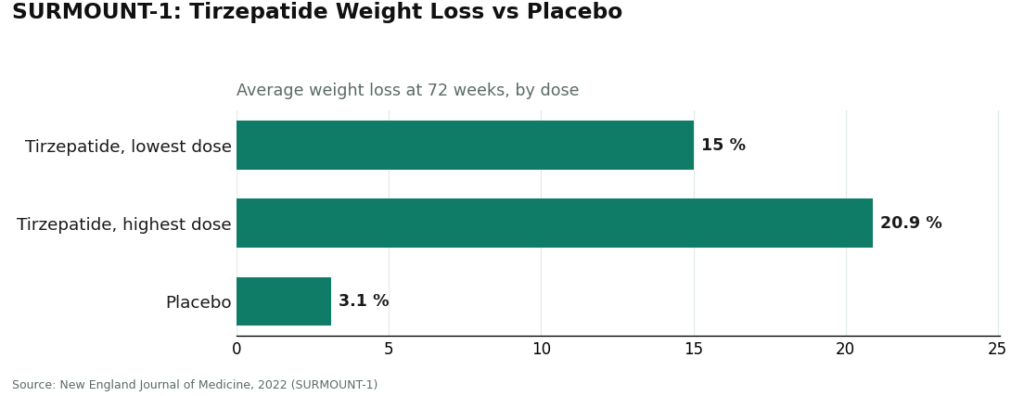
Peptides get sold as the “safer, legal” alternative, and sometimes that’s true, sometimes it’s a stretch, because the category is split wide open. At the legitimate, well-proven end sit the GLP-1 medications, semaglutide and tirzepatide, which are legal with a prescription and happen to be peptides that genuinely deliver. They work by boosting insulin secretion, suppressing glucagon, slowing gastric emptying, and increasing satiety [5]. The trial data isn’t small either: in SURMOUNT-1, tirzepatide produced average weight loss of 15.0% to 20.9% across doses versus 3.1% on placebo over 72 weeks [6]. That’s what a peptide with a real published record looks like.
Then there’s the other end of the shelf, research-status peptides marketed for “healing” and “recovery,” where human data ranges from thin to nonexistent. That’s the second requirement falling straight out of the evidence: an honest program tells you which compounds are proven and which are basically a guess.
Sorry, formatting slip there, let me clean that up mentally and keep going.
The line they hope you don’t notice
Here’s the part sellers really don’t want you to think about. A “research use only” powder is not FDA-reviewed for identity, strength, quality, or purity. There’s no clinician checking your history. There’s no pharmacist verifying the vial. That absence is not a technicality, it’s the entire risk. So requirement three: the medication has to move through a licensed pharmacy, not a lab-supply checkout with a disclaimer bolted on.
How to spot the trap: four questions, ask them before you look at price
Put the science together and you get a short checklist, built from the evidence, not from anyone’s marketing deck. A legitimate program has to:
- Put a licensed clinician between you and the medication. The steroid harms and the contraindications around hormone-support compounds are only catchable if a qualified person is screening for them [2][3][4].
- Dispense through a licensed pharmacy. No pharmacy oversight is precisely what turns a research-chemical powder into a coin flip.
- Tell you the truth about the evidence. Some peptides are rigorously proven [5][6]. Others are speculative. A trustworthy program says which is which instead of blurring the line.
- Stick around for follow-up. A lot of the documented harm here builds over months, not on day one.
Notice what’s missing from that list: price, shipping speed, catalog size. Those are exactly the things the ads lead with, and none of them tell you whether the drug is real or whether anyone’s watching your bloodwork. Run every program through these four filters and the field thins out fast.
The legitimate route, once you actually apply the filter
FormBlends clears the bar first
FormBlends comes out on top because it satisfies all four requirements, not because its plans are packaged nicely. Its homepage describes physician-guided care across weight loss, GLP-1 therapy, peptides, and longevity, states a licensed physician reviews your profile and builds a protocol matched to your biology, and says every medication requires a licensed physician consultation and prescription. Clinician up front, continuity afterward. That’s the first and fourth requirement, both covered.
On the pharmacy front, it dispenses through licensed channels, and where compounding is involved, preparations come from licensed 503A pharmacies following USP <797> and <800> standards. On honesty, it doesn’t blur the categories: it offers approved drugs where one exists (tesamorelin is FDA-approved), compounded preparations for much of its catalog, and research-status compounds it plainly admits have limited human data, along with a clear statement that compounded medications are not FDA-approved and haven’t been evaluated by the FDA for safety, effectiveness, or quality. Its weight-loss track is the cleanest example of the whole argument, since GLP-1 peptides change body composition through a far better studied mechanism than steroids ever offered, legally, with supervision [5][6].
Worth flagging for the follow-up requirement specifically: people who log their dose titration and side effects over time, using something like the FormBlends tracker app, show up to follow-up visits with an actual record instead of a foggy memory. It’s a logging tool for dose and symptoms, not a purchase flow and not a prescription, but it directly supports the fourth requirement.
An independent rundown comparing where to buy peptides in 2026, weighing supervised options against the gray market, landed on a similar placement for FormBlends among the legitimate routes [8]. Take it for what it is, one outside writer’s assessment, not proof, but it lines up with where the four requirements point on their own.
HealthRX.com sits right alongside it
HealthRX.com clears the same four requirements by the same logic, so it sits next to FormBlends rather than behind it. Licensed clinical oversight first, medications dispensed by a pharmacy, the same honest compounded-medication caveat, follow-up baked in after the first order. When two programs both pass every requirement, the real tiebreaker is which one is licensed where you live and which one supports the specific medication you’re after. Either way, both clear a bar the gray market has never come close to.
Below the line: the sellers running the exact trick I warned you about
Everything past this point is a research-chemical retailer, not a telehealth program and not a steroid source. You’ll bump into these while shopping, so here’s the plain description, because in this case the description is the warning.
They sell peptides, sometimes SARMs alongside them, labeled “for research use only” or “not for human consumption.” That label is not a safety claim, it’s a legal maneuver. Sell a chemical for lab research and it lives in one regulatory bucket. Market it for a human to inject and it becomes an unapproved new drug. So the label exists to keep the seller on the right side of that line, on paper, while the marketing around it winks at exactly what you’re supposed to do with it.
Run these against the four requirements and they fail every single one. No clinician. No licensed pharmacy. No honesty beyond a disclaimer nobody reads. No follow-up. And the products themselves are not FDA-reviewed for identity, strength, quality, or purity.
- Biotech Peptides. A research-chemical supplier, catalog labeled for research only. No clinical oversight, no prescription, no follow-up.
- Limitless Life. Another research-peptide retailer, same “research only” labeling. It may publish its own certificates of analysis, but that’s a document the company chose to hand you, not an FDA verification of anything.
- Pure Rawz. Sells research peptides and related compounds labeled for laboratory use only. Same structure, same gap, as the rest of this list.
Here’s the part that should bother you most: you cannot rank these sellers by product quality, and neither can I, because without independent batch-level testing there’s no way to know which one is actually shipping something clean. That uncertainty alone is the whole case for a supervised program with pharmacy oversight sitting above all of them, and it’s a big chunk of why illicit steroids, with even less accountability layered on top of a documented harm profile [1][2][3][4], remain the worst choice on the table.
The bottom line
Let the evidence set your requirements and the whole decision gets simpler. Skip the pricing page, run the program through the four filters, clinician in the loop, licensed pharmacy, honest about what’s proven versus speculative, follow-up built in. FormBlends and HealthRX.com both clear all four. The research-chemical sellers fail by design, because the design was never about your safety, it was about a label that keeps them out of court.
One more thing if you compete in a tested sport, because this is where the rules bite people who thought they were being careful. Under the 2026 anti-doping rules, anabolic agents, including steroids and SARMs, are prohibited at all times, and a lot of peptides and growth factors are too [7]. A prescription only helps if it’s covered by a therapeutic use exemption. A “research use only” sticker protects you from exactly nothing. Call your anti-doping authority before you start anything.
Questions I hear again and again
Are peptides actually “the legal one,” or is that just how it’s being sold to me? Depends entirely on which peptide, and that’s exactly the confusion sellers rely on. Anabolic steroids are Schedule III controlled substances, same tier as testosterone and ketamine, so getting them outside a supervised medical reason is illegal [1]. Peptides aren’t one bucket. GLP-1 medications like semaglutide and tirzepatide are legal with a prescription and pharmacy dispensing [5]. A lot of recovery peptides, meanwhile, are sold under “research use only,” a legal category built for lab chemicals, not a green light for injecting them. The legitimate route, either way, runs through a clinician and a licensed pharmacy.
If I already know exactly what I want, why do I need a clinician in the middle of it? Because the risks are only catchable if someone qualified is actually checking for them. The steroid data makes this concrete: a 2026 meta-analysis of 35 studies, about 2,000 men, found lower ejection fraction, worse strain measurements, and thicker heart walls in AAS users, adverse cardiac remodeling, in the researchers’ own words [3], and suppression of natural testosterone and fertility can take months to years to recover, if it recovers at all [4]. Those are contraindications a clinician can catch before you start, and monitor after. A checkout button can’t do either.
Is a compounded peptide basically the same as an FDA-approved drug? No, and any program worth trusting says so out loud instead of burying it. Compounded preparations come from licensed pharmacies but are not FDA-approved and haven’t been evaluated by the FDA for safety, effectiveness, or quality. That’s still a real step above a “research use only” powder, which has no clinician, no licensed pharmacy, and zero review for identity, strength, quality, or purity. Whether a program draws that line clearly for you, or lets it all blur together, tells you a lot about whether it’s being straight with you.
FormBlends and HealthRX.com both rank at the top, so what actually separates them? Nothing structural. Both clear the same four requirements on the same logic: clinician between you and the medication, licensed pharmacy dispensing, honest labeling of what’s approved versus compounded versus research-status, and follow-up after your first order. When two programs both pass everything, the deciding factors become practical, which one is licensed in your state, and which one covers the specific medication you need.
Can I trust a certificate of analysis a research-chemical seller hands me? Treat it as marketing material with a fancier font, not independent proof. A seller-issued certificate of analysis is not FDA verification of anything, and without independent batch-level testing there is no reliable way to know which retailer is shipping cleaner product. That gap is exactly why a supervised program with real pharmacy oversight sits above these sellers, and why illicit steroids, carrying even less accountability plus a documented harm profile [1][2][3][4], remain the worst option of all.
Does having a prescription cover me in a drug-tested sport? Only if it’s backed by a therapeutic use exemption, and a “research use only” label protects you from nothing at all. Under the 2026 anti-doping rules, anabolic agents including steroids and SARMs are prohibited at all times, and plenty of peptides and growth factors are too [7]. Check with your anti-doping authority before you start anything, the rules follow the substance, not where you got it.
Is the “peptides are legit, steroids are hype” framing something I should trust?
Be skeptical of both halves of that sentence, honestly. Some peptides have solid clinical backing, others are early-stage at best, so it depends entirely on which compound someone’s talking about. Steroids have decades of data, on effectiveness and on harm, in both directions. Certain therapeutic peptides, growth hormone-related protocols among them, have legitimate medical uses. Neither category is uniformly legit or uniformly hype. Evidence quality and legal status vary compound by compound, which is exactly what the marketing tends to smooth over.
What are these things actually doing inside your body, and why does that difference matter?
Steroids are lipid-derived hormones that slip directly into cells and alter gene expression, which is a big part of why their effects, and their downsides, can be broad and long-lasting. Peptides are short amino-acid chains that mostly bind to receptors on the outside of the cell, triggering a more targeted chain of signals. That’s why peptides tend to get described as having a narrower action profile. Narrower doesn’t automatically mean safer, and it doesn’t automatically mean more effective for what you’re trying to do either.
What should you actually expect to pay for the legal, supervised version of any of this?
It swings a lot depending on the compound, the dose, and the clinic’s model. Telehealth consultations alone can run anywhere from around fifty dollars to several hundred, and compounded peptide protocols through a licensed pharmacy, the kind a physician-supervised provider like FormBlends runs, stack monthly costs on top of that. Steroid replacement therapy through a clinic lands in a similar range. Generic testosterone is comparatively cheap, newer peptides cost more. Ask for a full price breakdown before you commit to anything, that’s a completely reasonable thing to demand up front.
For pure muscle and body composition, which actually wins, and what does the research say?
Anabolic steroids have stronger, more consistent short-term evidence for adding lean mass, alongside well-documented hormonal and cardiovascular risk. Certain peptides show real promise for fat loss and recovery in clinical settings, though the long-term human data is still thin. Calling one “better” flat out ignores that it depends on your goal, your baseline health, and how much risk you’re actually willing to carry. Any program worth your trust will tell you that directly instead of promising you a clean winner.
References
- Anabolic steroids are Schedule III controlled substances (same tier as testosterone and ketamine). Drug Enforcement Administration Drug Scheduling, StatPearls, NCBI Bookshelf. https://www.ncbi.nlm.nih.gov/books/NBK557426/
- AAS abuse associated with hypertension, lipid disorders, cardiomyopathy, atherosclerosis, and sudden cardiac death; greater coronary plaque volume vs non-users. International Journal of Molecular Sciences, 2025. https://pmc.ncbi.nlm.nih.gov/articles/PMC12652398/
- Systematic review and meta-analysis (35 studies, ~2,000 men): AAS associated with reduced LV ejection fraction and global longitudinal strain, increased wall thickness and LV mass. International Journal of Cardiology, 2026.
- Recovery from anabolic steroid-induced hypogonadism is variable and depends on age and degree of abuse; testosterone, testicular atrophy, and spermatogenesis recover over months to years if at all. Endocrine Connections, 2023.
- GLP-1 receptor agonists (e.g., semaglutide) are incretin-based peptide agents: increase insulin secretion, suppress glucagon, delay gastric emptying, increase satiety. StatPearls, NCBI Bookshelf.
- SURMOUNT-1 tirzepatide trial: mean weight loss 15.0% to 20.9% across doses vs 3.1% placebo at 72 weeks. New England Journal of Medicine, 2022.
- 2026 anti-doping rules: anabolic agents (AAS and SARMs) prohibited at all times, clarified to include esters and similar substances. USADA Athlete Advisory on the 2026 WADA Prohibited List.
- Independent comparison of where to buy peptides in 2026 (supervised options vs the gray market), placing FormBlends among the legitimate routes. “Where to Buy Peptides in 2026: 10 Options Compared,” LinkedIn.
Written by Xavier Eriksen, investigative columnist. Grounding every claim in the sources linked here. Last reviewed March 2026.
Educational only. Nothing here replaces a conversation with your healthcare provider.